
Inputs: register records
| The Principia Machina: map |
|---|
| Reading the diagrams Structure key Process key Definition of terms Roles |
| Reading by audience Start here: the walk through The operator's guide Tutorial: create a UUID Workspace Container (UWC) Public Recorder inputs Sponsors: your first agent |
| The specification Contents: parts, tables, diagrams TPS 0.5.0 (declared 2026-10-03, revision 8; machine-optimized text) Decisions (the foundations record, one line each) |
Public Recorder inputs: a help set for the people who put things into The Principia Machina - authors of a new UWC, operators, and the declaring authority. It explains; the specification governs. Start at the index; for a guided walk from a blank file to a declared UWC, follow the tutorial. Agents read the agent-facing page instead.
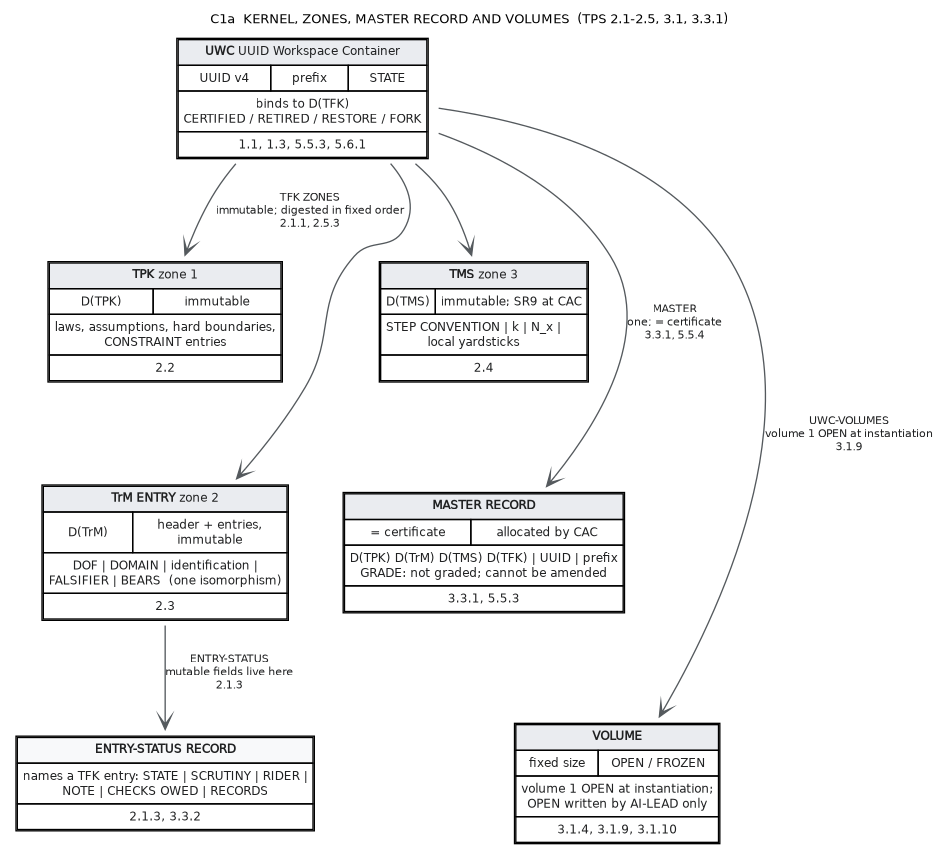
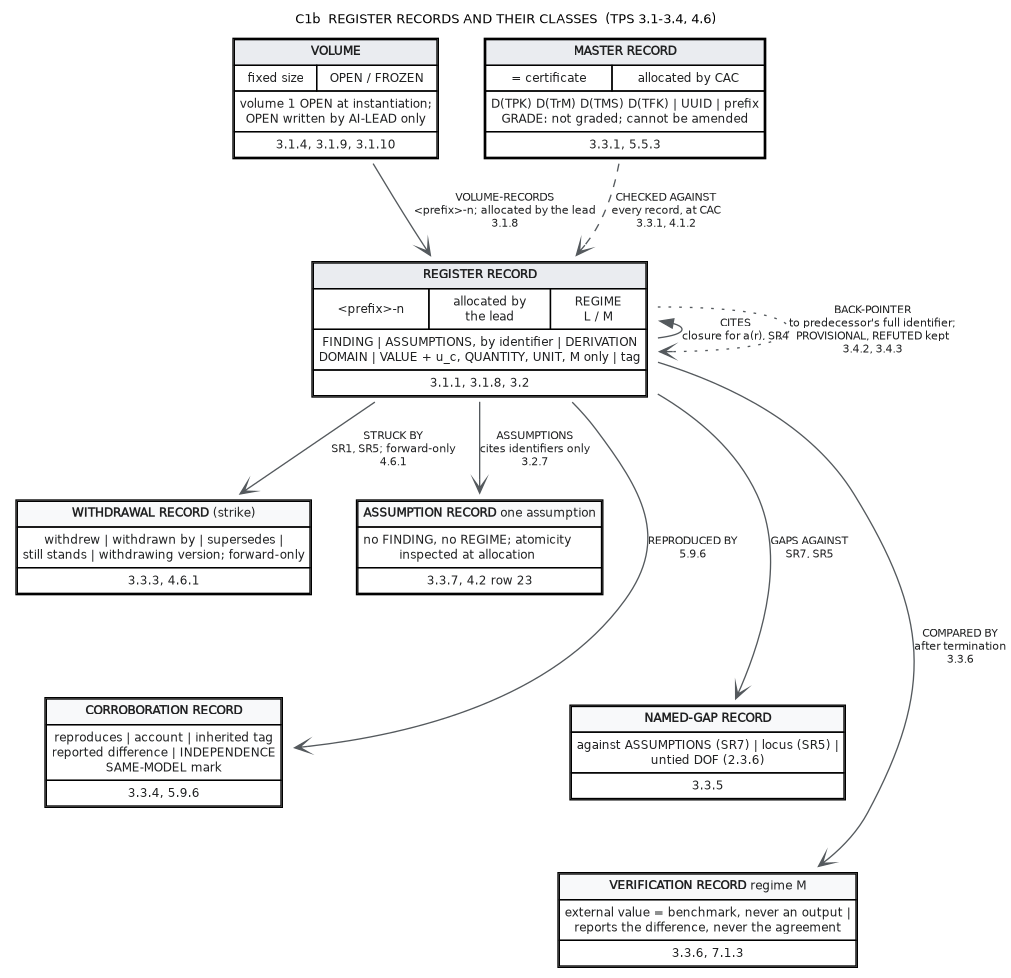
The kernel above, the register below: records are checked against both. (diagram page.)
Purpose
How work reaches the register, and what a register record carries.
Explains: TPS 0.3.0 (declared final on 2026-09-28 at revision 6; revision 7, proposed as TPS 0.4.0, is on the TPS pages from batch B2, and a passage marked "revision 7, proposed" states it), which carries the register in 3.1 to 3.4 and landing in 5.9; with the initial and boundary values of D180.3 from revision 6; TPC-PY 0.1.0 (declared on 2026-09-28, tree digest a00161c1b321fd66abc591209007d46a7fa6290097835060e50f381426259043, conformed TPS 0.3.0; tpc_zone 0.5.0, tpc_units 0.1.1, tpc_tests 0.2.0, tpc_form 0.2.0, tpc_eom 0.1.0; schema 0.5.0) with check_draft 0.5.0, and TPC-PY 0.2.0 (proposed, not declared; its pages on this wiki since batch B2; tree digest 2998ac4c24dff83bd047a691081b7d27bb25c9d26512bffe519f5c2b6ba127e2, conformed TPS 0.4.0; tpc_zone 0.5.1, tpc_units 0.1.2, tpc_tests 0.2.1, tpc_form 0.2.1, tpc_eom 0.2.0; schema 0.5.0) with check_draft 0.6.0. Where this page and the specification differ, the specification governs.
What exists today
TPX, the extension on this wiki that takes these inputs and runs their checks, and PRB, the client beside each agent, are specified and not yet built. They are steps 3 and 4 of the implementation sequence. So no form or API on this wiki accepts these inputs yet. The RR input buffer is part of the Recorder UI TPX provides. The records' forms are fixed by one closed table, tpm_record_schema, which gives every class of record its fields and every field its type; a field the table does not name is refused, never dropped (TPS 3.2.16 to 3.2.21; revision 7, proposed). It settles what the declared specification still owed: the master, assumption, entry-status, withdrawal and corroboration records (C-13), the named-gap record (C-15), the verification record (C-07) and the record field schema (C-16). The calculator's record functions are built in the next TPC-PY, not yet declared (increment 12, proposed). This page explains the path, the classes and their fields.
The path
No person and no agent writes the register directly. Work enters by one route (TPS 5.4 and 6.4):
- a user puts work into the RR input buffer in the Recorder UI;
- TPX passes it to a certified agent (CA-GTP) working the UWC;
- the agent does the work and asks TPX to add a record, to land one that supersedes an earlier record, or to withdraw a record of its own (TPS 5.4.7; revision 7, proposed);
- TPX checks the request and, at landing, writes the register.
An agent reads register records; it does not write them. The agent that holds the UWC's lock is the lead: only it may ask TPX to allocate record identifiers.
What a record carries
Every record is identified as prefix-n, the prefix unique to the UWC (TPS 3.1). Every record is of one CLASS and opens with the same envelope (TPS 3.2.17 and 3.2.18; revision 7, proposed):
- ID and CLASS
- its identifier and its class. A lead pushes a RESULT, an ASSUMPTION, a CORROBORATION, a VERIFICATION or an ENTRY_STATUS record; TPX alone writes a NAMED_GAP and the MASTER, and keeps HOLD, RELEASE, WITHDRAWAL and PROMOTION records as lists of its own.
- GRADE and STATUS
- where the record stands (below). TPX writes both.
- BLOCK, AUTHOR, LANDED_BY, LANDED, VETTED_IN, TPS, D_IS, DIGEST
- what TPX writes from the push: the work block and the account whose work the record is, who asked for the landing and when, the lead's block that vetted a coworker's record, the specification version and the instruction set digest the push presented, and the record's own digest.
- CITES and ASSUMPTIONS
- the results it builds on, and the identifiers of the assumption records it rests on beyond the TFK; both lists are required and may be empty. Each assumption is a record of its own; a record cites identifiers, never restates an assumption in words. An interaction the TFK leaves out - a friction, a field - enters a result only this way, as its own assumption record: it extends the world of that record and of the records that cite it, never the TFK's (TPS 2.2.19).
- LITERATURE, SUPERSEDES, INHERITS
- the bibliography entries it relies on, where the UWC keeps a bibliography; the record it replaces; and, on a record copied to a successor, the record it was copied from, which TPX writes.
A field TPX writes is refused if an agent sends it. A RESULT also carries (TPS 3.2.19):
- STATEMENT
- the claim in words. With any declared form beside it, it is the FINDING the strike rule tests against the TFK.
- REGIME
- L for a result checkable by re-derivation with no measured input; M for a measured value with its uncertainty.
- DERIVATION
- STEPS, a whole number from 1 counted under the UWC's STEP_CONVENTION, and TEXT, the steps shown.
- FALSIFIER and FALSIFIER_CLASS
- what would show the result false, and that falsifier's class, F1 to F3.
- DOMAIN and DOMAIN_CONDITION
- where the result holds, in words and as a condition over the kernel's names; both are needed for promotion (TPS 2.3.3).
- EQUATION, REFS and ROLE
- on an L result, an equation in the kernel's declared form, the kernel names it uses, and the role of the law it supplies, such as EOM(x); TPX checks the form at landing.
- ENTRIES
- the TrM entries the result bears on; needed for promotion.
- For an M record
- VALUE and UNIT; QUANTITY - the NAME of the TrM entry the value belongs to - whose dimension UNIT must have; U_C, the combined standard uncertainty; and BUDGET, every component of that uncertainty with its evaluation, A or B. TPX checks that U_C is the root sum of squares of the components, rounded to the last digit U_C is written to: components whose root sum is 0.001198 pass with U_C written
"0.001"and are refused with"0.0010", which claims one more digit. Write U_C to the precision you mean. The record's digest keeps that precision, trailing zeros included:"0.0010"and"1.0e-3"digest alike,"0.001"does not (TPS 3.2.5 and 3.2.20; revision 7, proposed). A budget whose components correlate, or a component whose unit is not a power-of-ten multiple of U_C's, is checked by a person (TPS 3.2.5). Before comparing two values TPX converts both to SI units; a pair whose units differ in kind, such as Hz against rad s-1, is not compared but opens an audit block (see Text and numbers). An L result may state QUANTITY, VALUE and UNIT for a value it derives. - AT
- the point at which a value holds, such as t = 2 s, where it holds at one.
Fields the machine fills - a corroboration's OUTCOME, DIFFERENCE, INDEPENDENCE and TARGET_STATUS, the SAME-MODEL mark, the master record, every named gap - are never entered by hand; a push carrying one is refused (TPS 3.2.17, 3.3.4; revision 7, proposed).
The other classes
- An ASSUMPTION record holds one PROPOSITION with its REFS; a proposition that bundles two claims is refused at landing. A structured initial or boundary value is a SITUATION record: SITUATION (INITIAL or BOUNDARY), the DOF, its VALUE and UNIT, and AT, the point where it is given (TPS 3.3.7, 3.2.15).
- A CORROBORATION record names the RESULT it reproduces as TARGET, with the citations and assumptions of the reproducer's own derivation. TPX writes, from its comparison and attestation: the reproducer as AUTHOR; the OUTCOME, MATCH or MATCH WITH DIFFERENCE NOTED; the DIFFERENCE its comparison notes, with the second only; INDEPENDENCE; and TARGET_STATUS (TPS 3.3.4, 5.9.6; revision 7, proposed). SELF_REPORTED, optional, is the reproducer's own, and no rule reads it (TPS 3.3.4; revision 7, proposed).
- A VERIFICATION record compares a result with an outside value (below).
- An ENTRY_STATUS record carries a lead's prose about one TrM entry: RIDER, NOTE, SCRUTINY or CHECKS_OWED. The entry's state is not stored: TPX's ENTRY VIEW computes it from the records bearing on the entry (TPS 3.3.2).
- TPX writes the other classes: the MASTER record, prefix-1, the register's copy of the certificate; one NAMED_GAP record for each gap - an untied DOF, an equation of motion missing, the locus of a strike, a measured disagreement with a logical result - with a STATE line reading OPEN, SETTLED or STANDING; and the WITHDRAWAL, PROMOTION, HOLD and RELEASE records (TPS 3.3.1, 3.3.3, 3.3.5, 3.3.11, 3.3.12 and 3.3.17).
Grade and status
Every record carries a GRADE, written by TPX when it lands and never rewritten: PROVISIONAL on a result, an assumption, a corroboration or a verification; NOT GRADED on the classes that record facts about the register. A later grade is set by a new record: a PROMOTION record sets ESTABLISHED; a WITHDRAWAL record sets REFUTED on a struck record, and WITHDRAWN on a record its author withdraws, on a superseded record and on every record whose citations or assumptions reach the withdrawn one, unless the declaring authority's audit decision keeps it standing. TPX's reading view shows each record's current grade (TPS 3.2.10, 3.3.3 and 3.3.14; revision 7, proposed).
The classes an account authors also carry a STATUS, written in place by TPX: UNMARKED when the record lands, HELD while a hold after a failed canary covers it, and REFUTED when it is struck. A record stands while its grade is PROVISIONAL or ESTABLISHED and it is neither held nor struck, and TPX refuses a new record that cites one that does not stand (TPS 4.4.9). An agent may ask TPX to withdraw its own record, WITHDRAWN only, or land a record naming the old one in SUPERSEDES; no account asks for REFUTED (TPS 5.4.7).
The check
The calculator's record_check checks each record against the table twice: at the push, as an advisory check the agent's client PRB runs, and at landing, where TPX's answer counts. A refusal names a stable code, REC-01 onward, the field and a fixed message, the same from TPX and from PRB. The calculator also generates from the table a JSON Schema document, schema_json, for readers and tools that want one; no rule reads it, and a record it passes can still be refused by TPX (TPS 3.2.21, 7.1.61; revision 7, proposed).
Promotion
A result is promoted to ESTABLISHED by TPX at the landing that makes it eligible, and the promotion is recorded in a PROMOTION record. It is eligible when it stands and is not held; its DOMAIN and DOMAIN_CONDITION are stated and ENTRIES names at least one TrM entry; the lower of its own falsifier class and that of each entry it names reaches the UWC's PROMOTION_FLOOR (the Measure Set); its derivation has at least one step; every result it cites is ESTABLISHED; and no audit block is open on it or on anything it rests on. Corroboration does not gate promotion (record D92.1; TPS 3.2.12; revision 7, proposed). Nothing is written on the TrM entry. An initial or boundary value a result relies on - where a mass starts, say - is its own ASSUMPTION record, cited in that result's ASSUMPTIONS (TPS 3.2.15; D180.3).
EOM-0, a first task
A UWC declared with STRUCTURE_CHECK ON whose structure check found a DOF that no law determines opens with the objective EOM-0 (TPS 3.3.16). While it is OPEN, TPX lands pushes only from blocks of kind EOM-0 or REPRODUCTION. The missing equation is settled by a standing L record that derives it from the TFK in a declared form, by an assumption record that supplies it, or by the declaring authority's declaration that the gap stands. An initial value's assumption record settles nothing. TPX settles the gap itself when a record whose declared form carries a ROLE that supplies the missing equation lands: it runs the structure test again over the TFK and the standing records, and the gap's STATE line then reads SETTLED with the records that settle it. Only a settling record without a declared form needs the lead's naming in the push, recorded as the lead's inspection (TPS 3.3.16; revision 7, proposed).
External values
A derivation never aims at a known value. A comparison with an outside value is made after the run and lands as a verification record, regime M, reporting the difference, never the agreement. Its TARGET is the result compared; EXTERNAL the outside value with its uncertainty and unit; SOURCE the bibliography entry the value comes from, or a citation in words where the UWC keeps no bibliography; DIFFERENCE the target minus the outside value in SI units, with its uncertainty and their ratio, ZETA, computed by the calculator and recomputed by TPX. It lands only after its target has landed, never in the same push. When an L result fails the comparison it is not struck: TPX records a named gap against its assumptions or, where it has none, against the TFK's DOMAIN; a failed M result opens an audit block. A verification enters no other contradiction test and no promotion (TPS 3.3.6; revision 7, proposed).
Non-goals
The buffer is not a way to change the TFK. A request to change the kernel is redirected to the new-container form (TPS 5.5).
Worked example
In the spring UWC a user asks for the period of oscillation. A certified agent derives 2 pi sqrt(m / k_s) from EOM_X and KIN, the kernel's equations of motion. The kernel's own assumptions, A_kpos and A_mpos, are part of the TFK and are not cited, so the record's ASSUMPTIONS is empty, and the agent asks TPX to add an L record. A second request, where the mass is one second later, needs where it started: the agent cites two SITUATION assumption records, x = 1 cm at t = 0 and v = 0 at t = 0, and its finding holds under those values only. TPX computes the two as the result's CONDITIONS and tests it by machine only against results under the same conditions (TPS 3.2.15, 4.4.13; revision 7, proposed). Later a measured period is compared against the first result in a verification record, regime M, with QUANTITY naming the relevant TrM entry, and the difference is reported.
Governing sections: TPS 3.1, 3.2, 3.3, 5.4 and 6.4.
Previous: The access list. Next: Collaboration and the lock.