
The kernel: what you promise not to change
| The Principia Machina: map |
|---|
| Reading the diagrams Structure key Process key Definition of terms Roles |
| Reading by audience Start here: the walk through The operator's guide Tutorial: create a UUID Workspace Container (UWC) Public Recorder inputs Sponsors: your first agent |
| The specification Contents: parts, tables, diagrams TPS 0.5.0 (declared 2026-10-03, revision 8; machine-optimized text) Decisions (the foundations record, one line each) |
The walk through, page 2 of 8. Written for the general reader; nothing here is a rule, and every rule it mentions is linked to the page of the specification that states it.
The kernel: what you promise not to change
At the heart of every container sits a small, locked object called the Full Kernel, the TFK. Think of it as the tunnel's walls. Everything inside the container is measured against it, and nothing inside may move it.
The Full Kernel has three parts, which the specification calls zones.
The first zone is the Prime Kernel, the TPK: the promises themselves. The laws you take as given, the assumptions you are willing to state out loud, the hard boundaries beyond which you will not go, and any deliberate restrictions, such as "we are only looking at a tabletop, in a uniform field". A restriction is not a weakening; it is one more promise, written in the same place as the others.
One rule about the promises matters more than it first seems, because it is about what is not written. The kernel asserts exactly what its entries say, and nothing else. If the promises do not mention gravity, there is no gravity in the container; the same holds for friction, air, electric and magnetic fields, and even for a number such as pi, which exists only if it is written down as a constant. Picture a mass on a spring, sliding on a track. If the kernel names only the spring, the mass feels only the spring: it does not fall, because nothing pulls it down, and it needs no track, because nothing has to hold it up. That is the point, not a trick: every influence in the container is one that someone chose and wrote down, so no result can quietly lean on one that nobody wrote. A single finding may bring an extra influence in, but only as one of its own stated assumptions, which counts against it and changes nothing for the kernel (section 2.2.19).
The second zone is the Translation Manifold, the TrM, and its name is more frightening than its job. The Prime Kernel speaks in its own terms; the world speaks in measurable ones. The Translation Manifold is the dictionary between them. Each entry says: this degree of freedom (DOF) in the promises corresponds to that thing in the world; here is where the correspondence holds; and here is what would prove it wrong. That last part matters. Every entry in the dictionary comes with its own way of being falsified.
The third zone is the Measure Set, the TMS: the yardsticks. When two findings disagree, how do we compare them? When is a difference between two measured numbers a real contradiction and when is it noise? The Measure Set fixes the rules of comparison before any finding exists, so that no one can bend the yardstick later to favor a result they like.
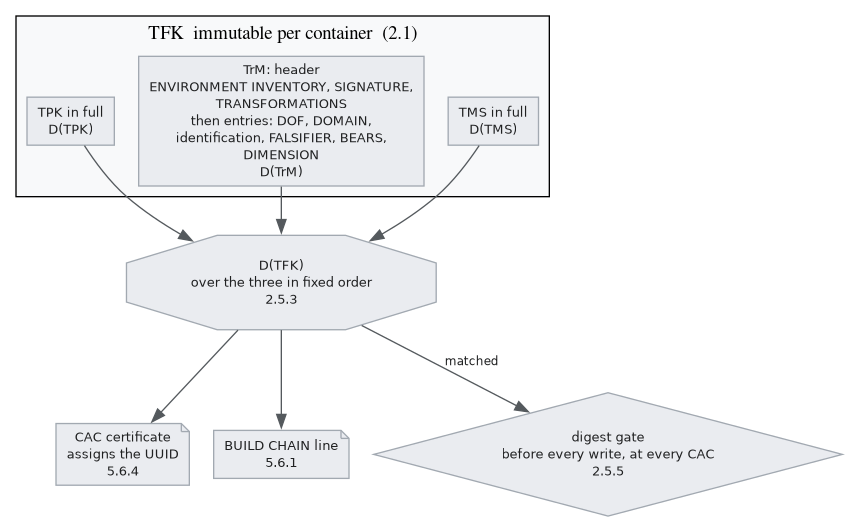
The three zones, each with its own fingerprint, and the fingerprint of the whole. (the diagram's page, with its source and a plain reading.)
Each zone has a fingerprint: a digest, computed by the machine from the exact text. The three digests combine into one fingerprint for the whole kernel. Before every single write into the container, the machine recomputes that fingerprint and compares it with the one recorded at the container's birth. If they differ, the container stops accepting writes until a person decides what happened. This is the tunnel wall being checked for cracks before every measurement.
And if you want to change a promise? You do not edit the kernel. You start a new container, with a new identity, that remembers where it came from. Findings can be carried across, but they arrive marked as provisional and must be re-earned under the new promises. The old container stays as it was, forever readable.
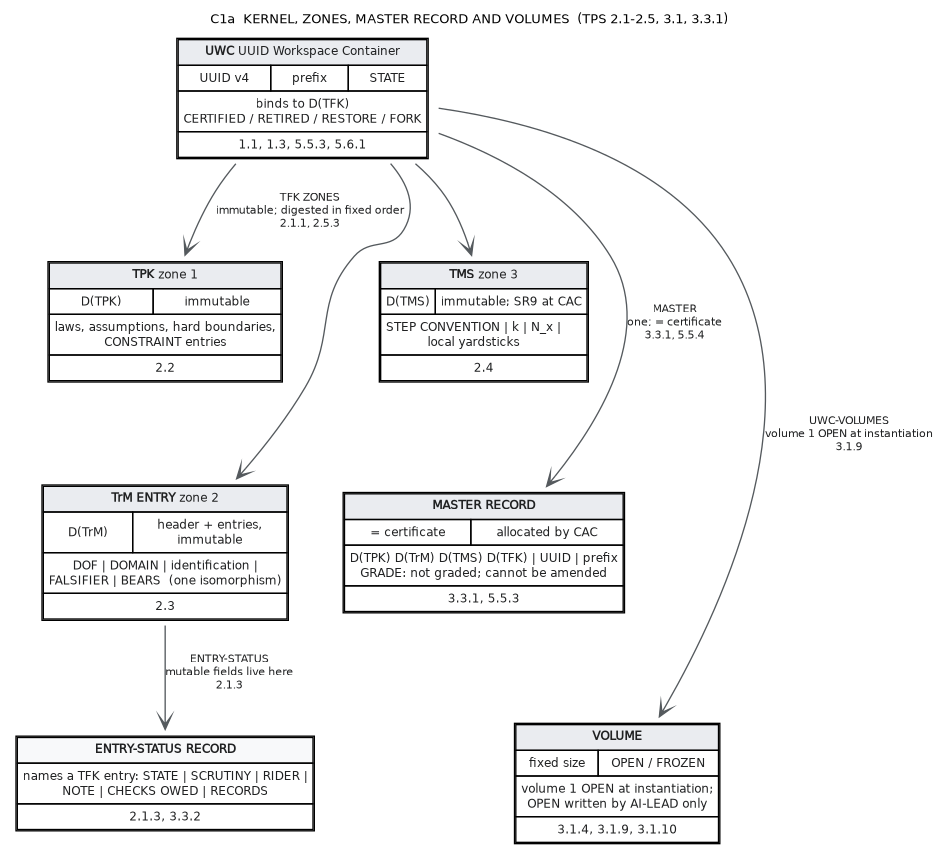
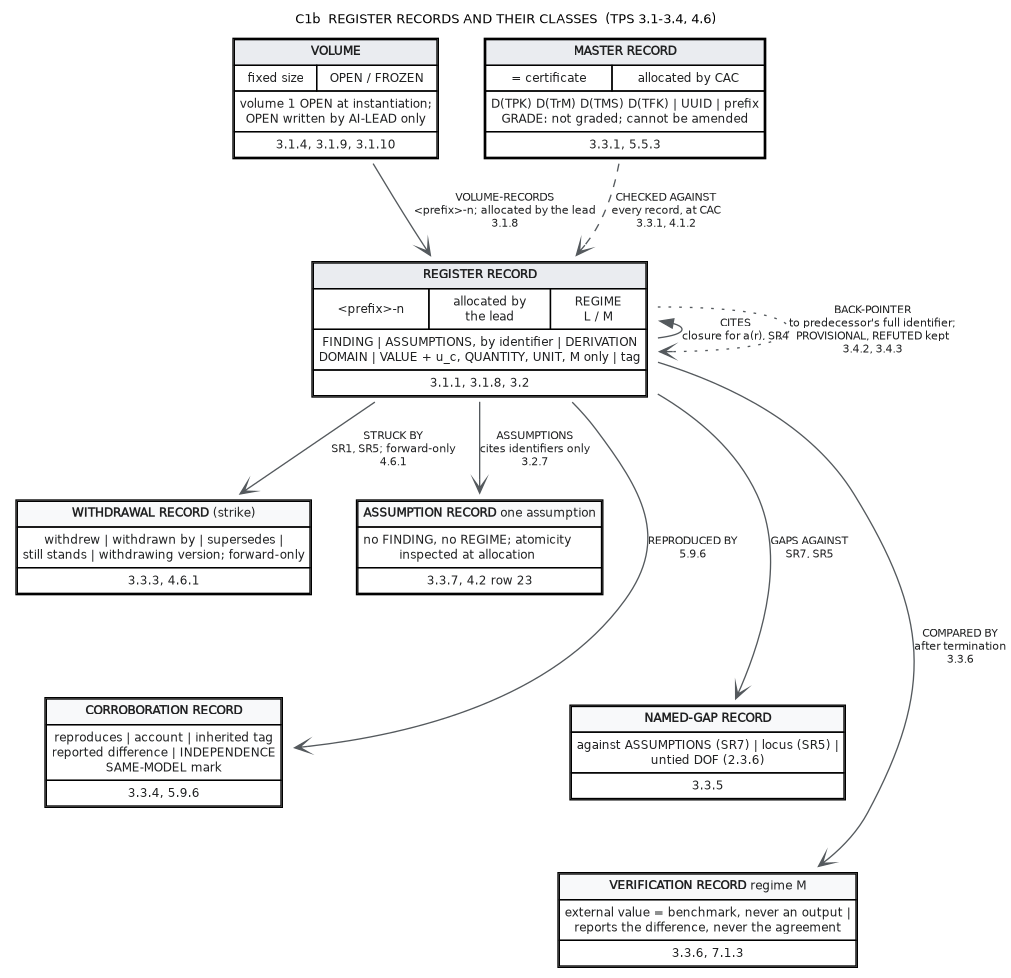
The kernel in Bachman form: each box a kind of record, each arrow a relationship the specification names. (the diagram's page, with its source and a plain reading.)
Among the promises, the laws that say how things move get one more check before the container is born. Each law says what it is for, and the machine, reading the laws written in the form it can read, asks one question: is every quantity that changes given by exactly one law? A changing quantity that no law gives becomes the container's first task; two laws that both claim one are put to a person. The author may switch this check off, and then no machine checks the equations at all. When the answer is clean, the machine calls the equations structurally regular. That word means only that they have the right shape, not that they are right or that they have a solution (section 2.2.20).
Writing common influences by hand, gravity near the ground or the drag of air, is tedious and easy to get wrong. So the form that creates a container asks one question first: which of a short list of interactions act on your system? Each one chosen is written into the kernel as ordinary promises the author can see, and the answer "none of these" is always offered. Nothing is added that is not chosen (section 5.22).
The rules behind this page: section 2.1 on immutability, section 2.2 to section 2.4 on the three zones, section 2.5 on the digests and the gate.
The dictionary has one more part, written once at the top before any entry: a list of the quantities on the world's side, each with its physical dimension; a list of the relations and operations the map has to carry over; and a list of the re-representations that count as saying the same thing, of which changing units is the plain example. Without that top section the promise "this map preserves the structure" has no structure to point at, and "these two numbers measure the same thing" has nothing to appeal to. The top section is part of the locked kernel, so it cannot drift after the fact.
Previous: A machine for testing ideas. Next: The register: every finding, in order.