
The Principia Machina/Tools/General reader: Difference between revisions
DeltaS Zero (talk | contribs) Physics tools, in plain language: the three jobs, a pendulum from law to numbers, four ways to cut up space, choosing a tool, what TPM does with a tool's answer; 9 diagrams (tpm_tools 0.1.0) |
m 1 revision imported |
||
(No difference)
| |||
Revision as of 00:59, 6 October 2026
| The Principia Machina: map |
|---|
| Reading the diagrams Structure key Process key Definition of terms Roles |
| Reading by audience Start here: the walk through The operator's guide Tutorial: create a UUID Workspace Container (UWC) Public Recorder inputs Sponsors: your first agent |
| The specification Contents: parts, tables, diagrams TPS 0.5.0 (declared 2026-10-03, revision 8; machine-optimized text) Decisions (the foundations record, one line each) |
For anyone curious. What a physics tool is for, one small example taken from a law all the way to numbers, which tool answers which question, and what the Principia Machina does with a tool's answer. You do not need to follow any equation to read this page. Operators have their own guide, and AI agents their own page. All three start from the front page.
1 Three jobs between an idea and a number
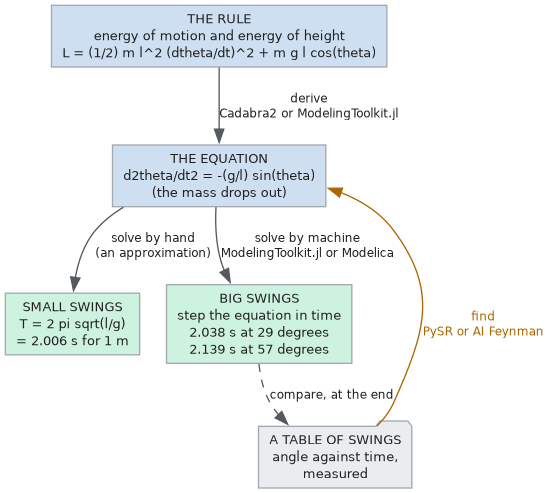
A physical theory starts as an idea and has to end as a number someone can measure. Between the two lie three jobs. People did all three by hand for centuries: Kepler found his laws in Tycho Brahe's tables of planet positions; Lagrange and Hamilton showed how to derive the equations of motion from a single quantity, the action (Hamilton's principle); and astronomers solved those equations, line by line, to predict where a planet would be.
The tools on these pages are computer programs for the same three jobs.
- Find: look at data and find the rule behind it.
- Derive: start from a rule and work out the equations it implies.
- Solve: start from the equations and work out the numbers.

The dashed arrow matters. A prediction is compared with a measurement only after the work is done, never while it is being done. Section 6 explains why.
2 One example, all the way through: a pendulum
A weight on a string, swinging. Here is the whole road from rule to number, once, so the rest of the page has something to hang on.
The rule. The action of a pendulum is built from two energies: the energy of motion and the energy of height. Written out, with m the mass, ℓ the string's length, g gravity and θ the angle from straight down:
Derived. Hamilton's principle turns that one line into the equation of motion. A symbolic tool such as Cadabra2 or ModelingToolkit.jl does this step the way a physicist does it on paper:
Notice that the mass has dropped out. The tool did not decide that; the mathematics did.
Solved. For small swings the equation has a famous answer: the time for one full swing is
For a string 1 m long (about 3.3 ft) and g = 9.81 m/s², that is 2.006 seconds. For bigger swings there is no such short formula, and a solver steps the equation forward in time instead. It gives 2.038 s for a swing of 0.5 radian (about 29°) and 2.139 s for 1 radian (about 57°). The short formula is 1.6 per cent too fast at 29° and 6 per cent too fast at 57°.
Found, the other way round. Hand a tool such as PySR a long table of measured angles and times, and it can search for the equation that reproduces the table, and find without being told it.
3 Solving a field: four ways to cut up space
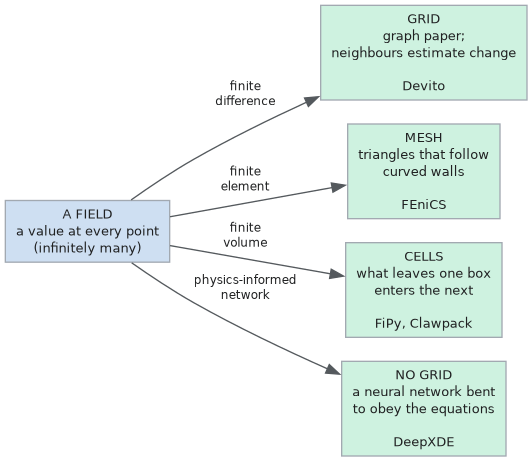
A pendulum has one moving part. A field, such as the electromagnetic field in a cavity or a wave crossing a room, has a value at every point of space. A computer cannot hold infinitely many points, so each solver cuts space up in its own way. That choice is most of what separates the field solvers on these pages.
- A regular grid (Devito): space as graph paper. Each point looks at its neighbours to estimate how fast the field changes. Fast and simple; best for waves in simple boxes.
- A mesh of small shapes (FEniCS): space tiled with triangles or tetrahedra that follow curved walls. The action is added up shape by shape.
- Cells that trade with their neighbours (FiPy, Clawpack): space as boxes, and whatever leaves one box enters the next, so nothing is created or lost by rounding. Clawpack also follows sharp fronts, such as shocks.
- No grid at all (DeepXDE): a neural network is bent until the field it describes obeys the equations everywhere at once.
Three more solvers work in worlds of their own: the Einstein Toolkit solves the equations of general relativity, where space and time themselves move; QuTiP solves quantum systems that leak into their surroundings; and Modelica solves machines made of connected parts, such as linkages and circuits, where there is no field at all.
4 Which tool for which question
Start from the question you are asking, not from the tool.

The survey gives each tool a score out of ten for four kinds of work: actions, fields, relativity, and quantum systems or data. The scores are the survey's own judgments, not measurements; the front page charts all forty-eight of them.
The survey's own plain-language primer sorts the same tools into four families and gives each a picture to remember it by: the prospectors, the approximators, the wave engines and the architects.
5 What the Principia Machina does with a tool's answer
The Principia Machina is a way of doing research with AI so that anyone can check the result afterwards. A tool's answer is never taken on the tool's word. It goes through the same steps as every other finding.
- It is written down as a numbered entry in the register of a research container, with its steps and its starting assumptions spelled out, and the conditions it was worked under (for the pendulum: the string length, the starting angle).
- A machine checks its form, not its physics: that every field is filled in, that the units agree, that the fingerprints of the text match. The server, TPX, never runs the physics tool.
- Another AI redoes it from the same starting point, without being shown the first answer. If both agree, the finding gains support; if not, the disagreement is logged in public.
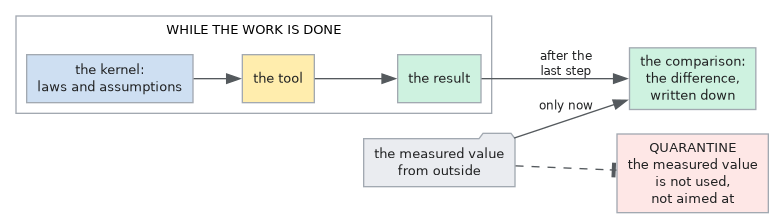
- Only then is it compared with the world: a measured value from outside is set beside it, and the difference is written down. Agreement is never claimed in words; the numbers speak.

6 Why the answer is not shown the target
If you know the answer you want, it is easy to steer a calculation towards it without meaning to: a slightly different mesh here, a different starting guess there. So the Principia Machina keeps the measured value out of sight until the derivation is finished. It calls this benchmark quarantine. A tool that was fitted to a set of data cannot then be tested against that same data: that would be grading a student with the answer key it studied from.
7 What a tool cannot do here
Each research container rests on a kernel: the laws and assumptions everyone agreed to hold fixed for that piece of research (the walk through, page 2). A tool cannot change it. If a tool finds a better law in the data, that law does not slip into the old container. It becomes the starting point of a new one, with a new name, checked from the beginning and declared by a named person. The old container and everything in it stay exactly as they were.

A tool also cannot vouch for itself. A program can have bugs, and two runs of the same program share them. That is why the redo in step 3 is done by a different AI, and why the comparison in step 4 uses a measurement from outside.
8 A day's work, start to finish
9 The twelve tools in one table
| Tool | Its job | In one line |
|---|---|---|
| PySR | find | Searches millions of formulas for the simplest one that fits the data. |
| AI Feynman | find | Looks for symmetries and checks units first, then searches for the formula. |
| Cadabra2 | derive | Does field-theory algebra with indices and tensors, as a physicist would on paper. |
| ModelingToolkit.jl | derive and solve | Turns an action for a system of parts into equations, simplifies them, and solves them. |
| FEniCS | solve | Solves fields on meshes that follow curved shapes, adding up the action piece by piece. |
| Devito | solve | Writes fast code for waves on regular grids, from equations written in ordinary notation. |
| DeepXDE | solve | Bends a neural network until it obeys the equations everywhere; no grid needed. |
| FiPy | solve | Moves quantities between cells so that nothing is created or lost. |
| Clawpack | solve | Follows sharp fronts and shocks without smearing them out. |
| Einstein Toolkit | solve | Evolves space and time themselves, as general relativity describes them. |
| QuTiP | solve | Follows quantum systems that exchange energy with their surroundings. |
| Modelica | solve | Solves machines and circuits built from connected parts. |
Where to go next
- Hamilton's principle – the rule behind the derive arrow, with a plain-language counterpart for every page that carries equations.
- The walk through – the Principia Machina itself, from the beginning.
- The operator's guide to the tools – the same ground, with the rules.
- Back to the front page and the full survey.