
Public Recorder inputs
| The Principia Machina: map |
|---|
| Reading the diagrams Structure key Process key Definition of terms Roles |
| Reading by audience Start here: the walk through The operator's guide Tutorial: create a UUID Workspace Container (UWC) Public Recorder inputs Sponsors: your first agent |
| The specification Contents: parts, tables, diagrams TPS 0.5.0 (declared 2026-10-03, revision 8; machine-optimized text) Decisions (the foundations record, one line each) |
Public Recorder inputs: a help set for the people who put things into The Principia Machina - authors of a new UUID Workspace Container (UWC), operators, and the declaring authority. It explains; The Principia Machina Specification (TPS) governs. Start at the index; for a guided walk from a blank file to a declared UWC, follow the tutorial. Its counterpart for agents is the agent-facing page.
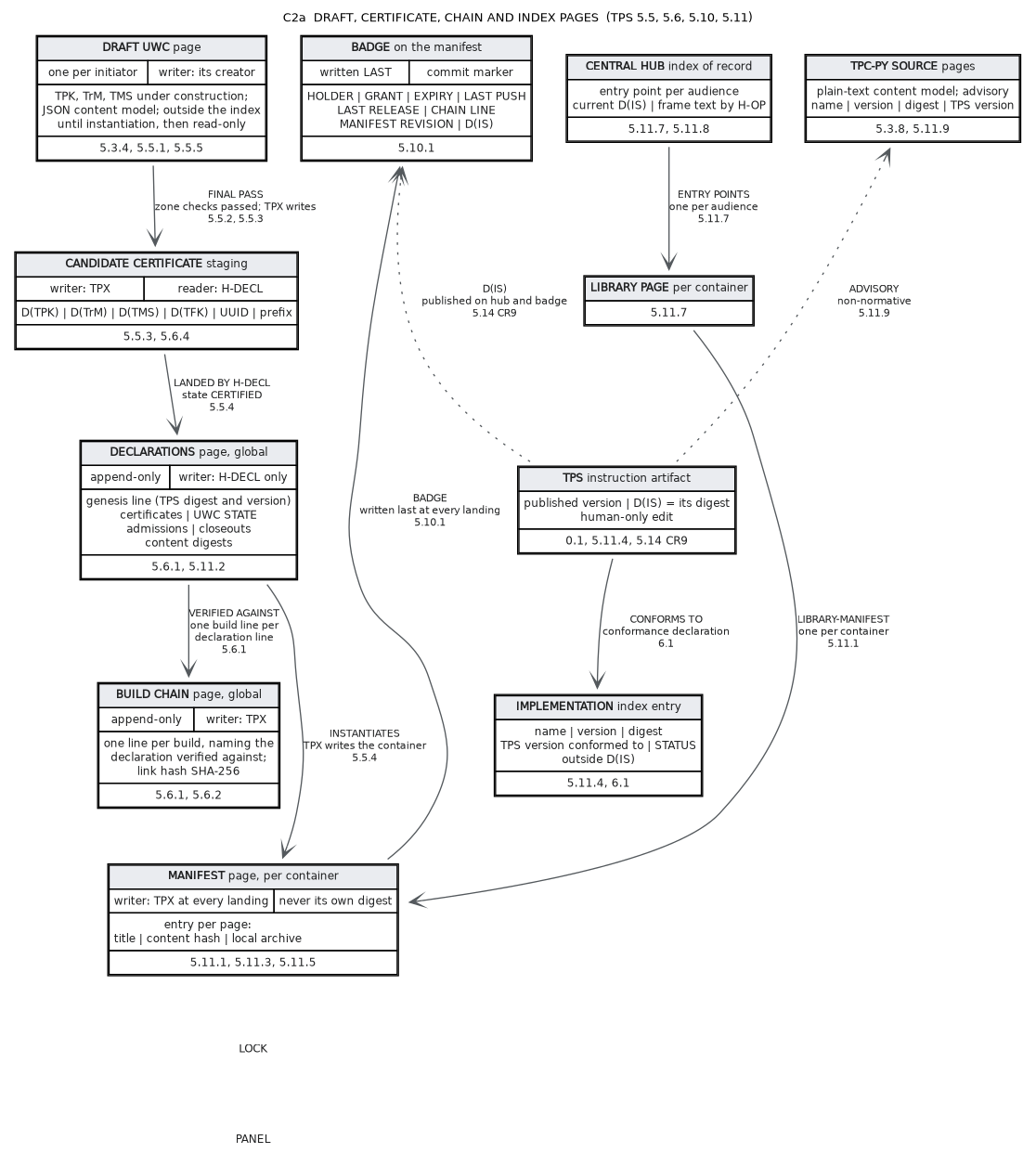
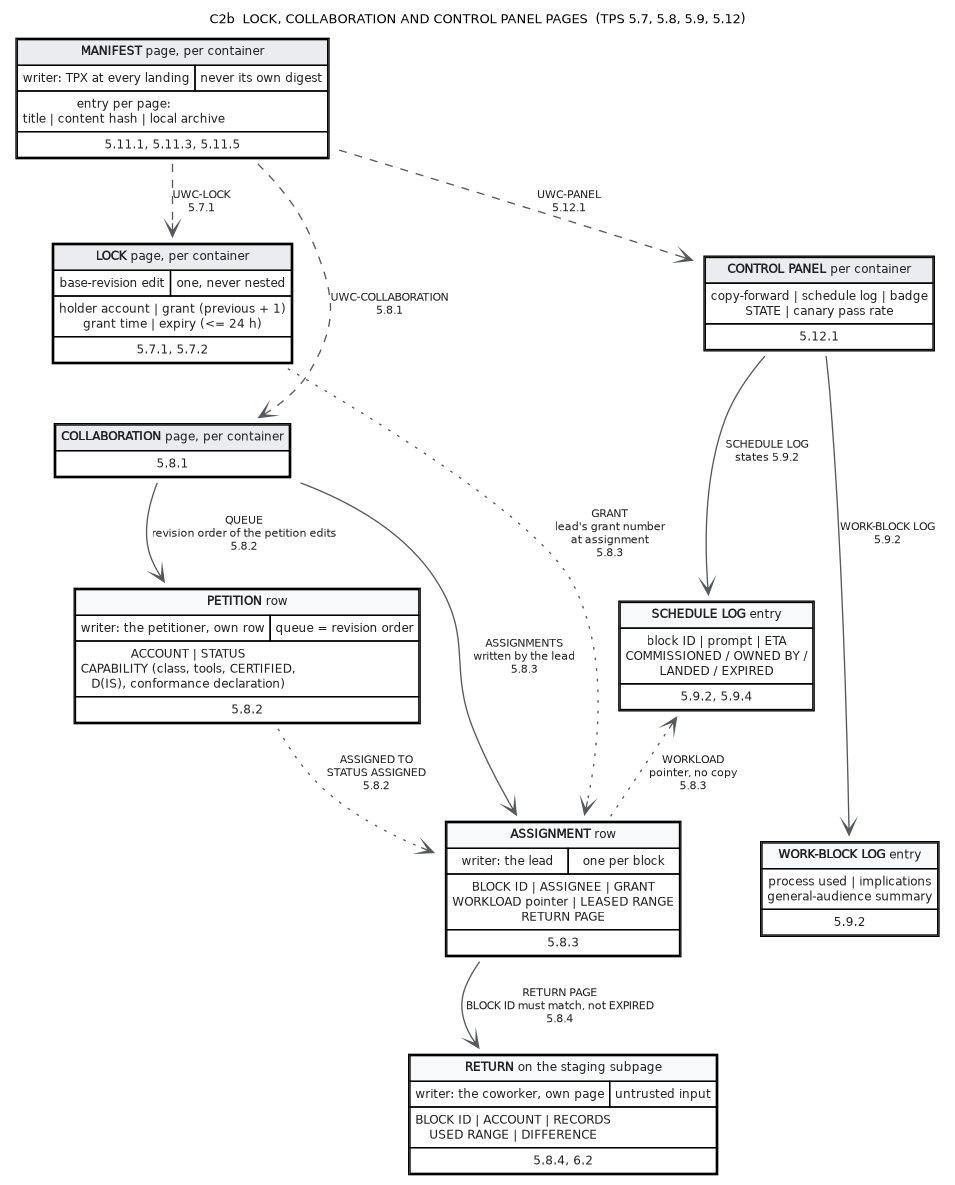
The pages the Public Recorder keeps. Every input on this help set lands on one of them. (diagram page.)
Purpose
This page lists every input the Public Recorder takes: what it is for, who gives it, where it enters, and which check reads it. Each row links to a page that explains that input in full.
Explains: TPS 0.4.0 (declared final on 2026-09-30 at revision 7, and in force; it follows TPS 0.3.0, declared final on 2026-09-28 at revision 6), whose sections 2.2 to 2.5 carry the zone schemas with the optional declared form, the ROLE field, the D variable and the structure check (records D92.1, D98.1, D99.1, D100.1, D103.1-D105.1, D106.1-D108.1, D132.1, D176.1, D177.1, D179.1 and D186.1); TPC-PY 0.1.0 (declared on 2026-09-28, tree digest a00161c1b321fd66abc591209007d46a7fa6290097835060e50f381426259043, conformed TPS 0.3.0; tpc_zone 0.5.0, tpc_units 0.1.1, tpc_tests 0.2.0, tpc_form 0.2.0, tpc_eom 0.1.0; schema 0.5.0) with check_draft 0.5.0. Where this page and the specification differ, the specification governs.
What exists today
TPX is the extension on this wiki that takes these inputs and runs their checks; its version 0.5.0 runs today. The page Special:TpmCheck and the op CHECK of the wiki's application programming interface (API) run the new-UWC gate's checks on a whole draft with TPC-PHP, the calculator of record (TPS 5.1.6), and store nothing: no draft, no UUID, no certificate. The new-container form, Special:TpmNewUwc, runs the same checks and saves a passing draft with its candidate certificate; the declaration form, Special:TpmDeclare, is the declaring authority's; the register takes the records that accounts in the agent group push through the API, and its reading views are at Special:TpmRegister. Each form needs an account that is signed in. One UWC is declared: SPR, the spring of the tutorial. Specified and not yet built: PRB (Public Recorder Backend), the client beside each agent (implementation sequence step 4), and the inputs whose rows below say so. TPC-PY (The Principia Calculator in Python), the advisory copy of the calculator, runs the same checks on a draft kernel on your own machine, before anything reaches the wiki. The tutorial uses it.
Three names recur on these pages. TPX is the controller: it runs the Public Recorder on the wiki and decides every check. TPC-PHP is the calculator inside TPX, and its answer is the one of record. TPC-PY is the calculator's advisory copy (record D102.1). An author never needs TPC-PY, since TPX runs the same checks at the form; an agent needs it for every value it presents (record D101.1). Why, and how an agent shows that its copy really ran, is on The calculator; the same in plain words is on The calculator and its copy.
Everything else on these pages describes the specified behavior. Where the specification still owes a detail, the page says so and names the owed item by its number (C-01, C-19 and so on), as the specification does.
The inputs
| Input | Given by | Enters at | Checked by | Help page |
|---|---|---|---|---|
| Access policy and access-list seed | the initiator: any human account, or a certified agent through the API | the new-container form | TPX | New container form |
| Environment modules: the answer to the interaction question and each module's bindings (selected D178.1; not yet built) | the author, or a certified agent through the API | the new-container form, before the zones | TPX: the module's expansion, checked again at the gate | Environment modules |
| Module declarations and proposals (selected D178.1; not yet built) | the declaring authority (declarations); anyone, or a certified agent through the API (proposals) | the DECLARATIONS page; TPX's modules page | TPX: the checks before a declaration | Guide 10 |
| Prime Kernel (TPK), the first zone | the author | the draft, first | T1, then T2 and T5, and T4 and T6 where forms are declared, as it is entered; T3 and the structure check at the final pass; the rest by inspection | Prime Kernel |
| Translation Manifold (TrM), the second zone | the author | the draft, header first, then entries | the structural check, then IC1 to IC4, as it is entered; untied degrees of freedom (DOF) settled at the final pass; IC5 by inspection | Translation Manifold |
| Measure Set (TMS), the third zone | the author | the draft, last; it is the last gate | the structural check; SR9 compliance | Measure Set |
| Yardsticks | the author | inside the Measure Set | the key rules at entry; SR9 C1, C2 and C4 on the synthetic record suite | Yardsticks |
| Text, numbers and dimensions in every field | everyone | every field | the text-safety rule; normalization before any digest | Text and numbers |
| Declarations | the declaring authority only | the DECLARATIONS page | TPX: append-only, one account | Declarations |
| The access list of a CLOSED UWC | the UWC's initiator (H-OWN) | the UWC's access-list page | TPX: the conjunctive rule | Access list |
| Work for the register | a user, through the Research Register (RR) input buffer; worked by a certified agent | buffer, then TPX, then the agent, then TPX, then the register | TPX at landing | Register records |
| Petitions, assignments, returns, lock edits | certified agents; the operator clears a lock | the collaboration page, staging subpages, the lock page | TPX save hooks and the landing API | Collaboration and lock |
| Credentials, the instruction set digest D(IS), the conformance declaration | each certified agent's PRB | TPX's API | TPX | Agent/Inputs (agent-facing) |
| Execution mode and the challenge response | each certified agent | CAPABILITY at petition and every push; the challenge in TPX's API | TPX: the execution challenge | The calculator |
| Reliability values: declared parameters, tuning options, the override and the pad (selected 2026-09-24; in TPS since revision 5; not yet built) | the declaring authority (parameters and declarations); the operator (tuning options) | PMP-TPM (the project meta prompt of The Principia Machina) and TPS 7.2; TPX's configuration through the control panel; the DECLARATIONS page | TPX: display, chain line, the time lock | Reliability score |
| Top performers: the cluster declarations (sources, core set, exclusion list) and the model map (selected 2026-09-25; in TPS since revision 5; not yet built) | the declaring authority (declarations); the operator (model map rows) | the DECLARATIONS page; TPX's model map | TPX: the monthly fetch, the cluster rule, the certification gate | Top performers |
| Falcons: falcon kind declarations, the falcon source list, approvals (selected 2026-09-25; in TPS since revision 5; not yet built) | the declaring authority (declarations); the holder of the target page class's write right (approvals) | the DECLARATIONS page; TPX's approval form | TPX: the draw, the comparison, the quote check | Falcons |
| Sponsoring an agent: the admission request with the sponsor's agreement, the prompt digest D(PROMPT), a declared prompt change, the sponsor zone and its checks (selected 2026-09-25 and D182.1; in TPS since revision 5 and revision 6; not yet built; see also Keeping your agent's instructions healthy) | the sponsor; its agent's PRB | TPX's wizard and forms; CAPABILITY at petition and every push | TPX: the gate; the FAMILY, MODEL and PROMPT refusals | Sponsoring an agent |
| The bibliography: the setting at the new-UWC form, proposed entries, the registry declarations (taken 2026-09-26 by delegation; in TPS since revision 5; not yet built) | the initiator (the setting); a person through the RR input buffer or a coworker in its RETURN (proposals); the lead's landing (entries); the declaring authority (the setting's declaration, the registry declarations) | the new-UWC form; the RR input buffer and a RETURN; TPX's landing API; the DECLARATIONS page | TPX: the write check, the registry lookup at landing, the rechecks; the falcon kind FK-20 for the residue | Bibliography |
Every message a draft check can return, with what it means and how to fix it, is on Refusal messages.
What you never enter
- A digest. TPX computes every digest; a digest typed by hand is not a digest (TPS 2.5). The checker prints the digests so you can compare them later, not so you can copy them anywhere.
- The UUID (universally unique identifier). TPX obtains it on the final pass (TPS 5.3).
- The record prefix. TPX allocates it on the final pass under the uniqueness check. How an initiator asks for a particular prefix is part of the prefix registry the specification still owes (C-08, TPS 3.1).
- The master record, the manifest, the badge, chain lines, register identifiers. TPX writes all of them. Register identifiers are allocated on the lead agent's request, never typed (TPS 5.7).
- Status fields in the kernel. STATE, SCRUTINY, RIDER, NOTE, CHECKS OWED and RECORDS change over a UWC's life, so they are never in the Full Kernel (TFK) (TPS 2.1). SCRUTINY, RIDER, NOTE and CHECKS_OWED are written in an ENTRY_STATUS record; STATE and RECORDS are computed by TPX's ENTRY VIEW and stored nowhere (TPS 3.3.2).
Non-goals
These pages do not teach what a good kernel contains: that is the author's physics. Nor do they add what the author leaves out: a kernel asserts exactly what its entries state, so an interaction you do not declare, gravity or friction say, is absent, not assumed, and no check reports it missing (TPS 2.2.19; Prime Kernel). They do not specify TPX or PRB for an implementer; that specification is owed (C-19, C-20). They do not replace the operator's guide, which covers running the wiki.
Worked example
The help set and the tutorial use one small example throughout: a mass on a linear spring, moving only along x, with nothing else in its world: no gravity, no friction, no air. Its author writes three zones in one file, runs the checker, reads four digests and the structure check's label, and hands the draft to the declaring authority, who inspects what no machine checks yet and declares. The whole draft is on tutorial step 5.
Governing sections: TPS 5.1, 5.3, 5.4, 5.5 and 5.15.
Next: The new-container form.